
Feline Lymphoma
Research, Resources & Education
This website is based on research and is NOT created to diagnose your pet.
Each animal is an individual and may exhibit symptoms in a different way.
It is advised that you ALWAYS CHECK WITH YOUR VETERINARIAN for a proper diagnosis and treatment plan.
Table of Contents
Feline Lymphoma
Lymphoma is a cancer of the lymphocytes. Lymphocytes are cells involved in the immune system and travel throughout the body in the blood and lymphatic vessels; therefore, lymphoma is always considered to be a systemic, not localized, disease.
(VCA)
Types of Lymphoma in Cats
Lymphoma can occur in several areas of a cat’s body.
- Intestinal lymphoma
- Mediastinal Lymphoma
- Renal Lymphoma
- Nasal Lymphoma
- Multicentric Lymphoma
(PetMD)
What is Feline Lymphoma?
What Is Lymphoma? (VCA)
What Is Lymphoma?
Lymphoma is a cancer of the lymphocytes. Lymphocytes are cells involved in the immune system and travel throughout the body in the blood and lymphatic vessels; therefore, lymphoma is always considered to be a systemic, not localized, disease.
- Lymphoma is connected with feline leukemia, a viral infection. More cats are now being vaccinated for feline leukemia; therefore, lymphoma is becoming less common. It is still frequently seen, accounting for approximately 30% of new feline cancer diagnoses. (VCA)
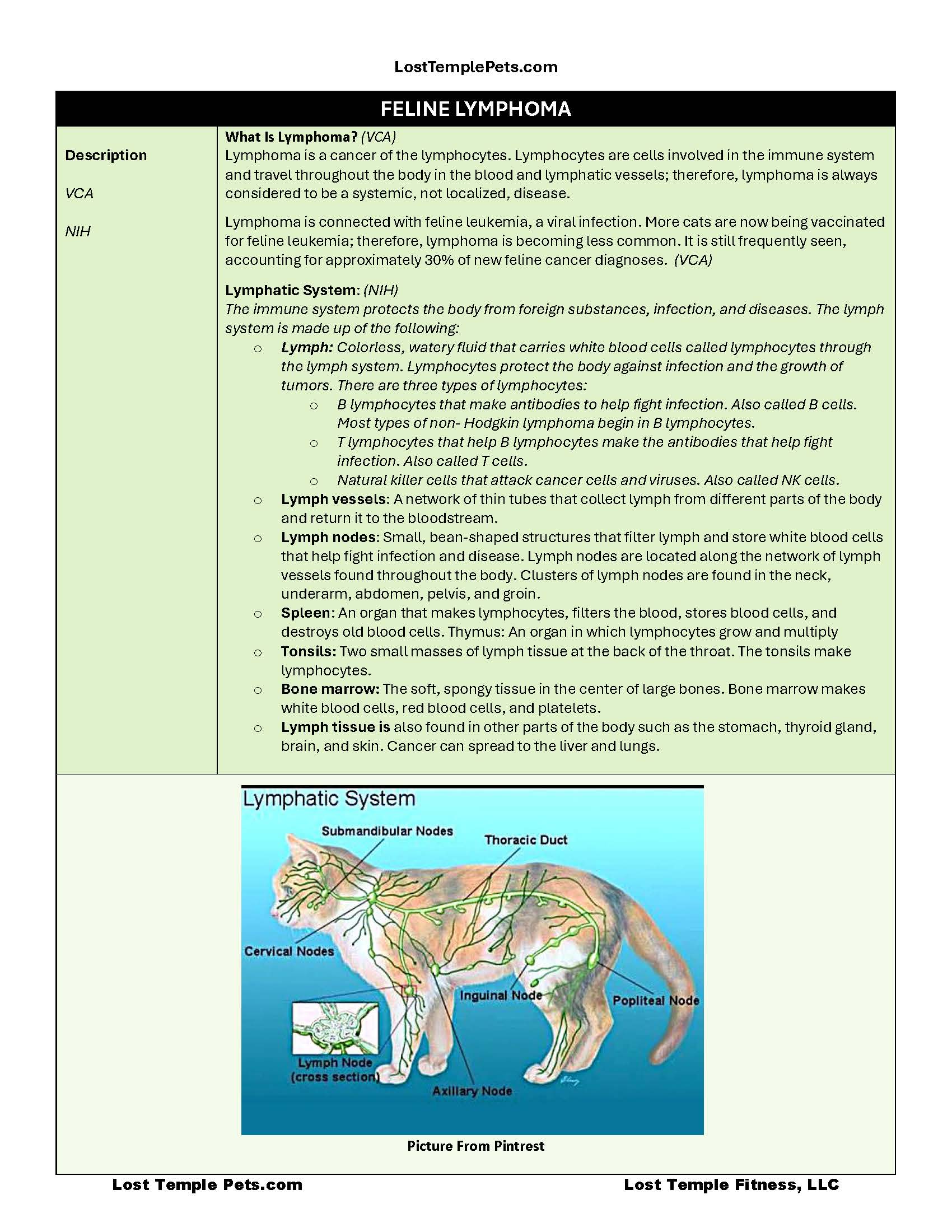
Lymphatic System: (NIH)
Lymphatic System
The immune system protects the body from foreign substances, infection, and diseases. The lymph system is made up of the following:
- Lymph: Colorless, watery fluid that carries white blood cells called lymphocytes through the lymph system. Lymphocytes protect the body against infection and the growth of tumors. There are three types of lymphocytes:
- B lymphocytes that make antibodies to help fight infection. Also called B cells. Most types of non- Hodgkin lymphoma begin in B lymphocytes.
- T lymphocytes that help B lymphocytes make the antibodies that help fight infection. Also called T cells.
- Natural killer cells that attack cancer cells and viruses. Also called NK cells.
- Lymph vessels: A network of thin tubes that collect lymph from different parts of the body and return it to the bloodstream.
- Lymph nodes: Small, bean-shaped structures that filter lymph and store white blood cells that help fight infection and disease. Lymph nodes are located along the network of lymph vessels found throughout the body. Clusters of lymph nodes are found in the neck, underarm, abdomen, pelvis, and groin.
- Spleen: An organ that makes lymphocytes, filters the blood, stores blood cells, and destroys old blood cells. Thymus: An organ in which lymphocytes grow and multiply
- Tonsils: Two small masses of lymph tissue at the back of the throat. The tonsils make lymphocytes.
- Bone marrow: The soft, spongy tissue in the center of large bones. Bone marrow makes white blood cells, red blood cells, and platelets.
- Lymph tissue is also found in other parts of the body such as the stomach, thyroid gland, brain, and skin. Cancer can spread to the liver and lungs.
Types of Lymphoma in Cats (PetMD)
Types of Lymphoma in Cats
Lymphoma can occur in several areas of a cat’s body. Before widespread vaccination for feline leukemia virus, lymphoma tended to occur outside the GI tract.
Intestinal lymphoma is most common, making up more than 50% of all lymphoma cases.
Typically, cats with lymphoma are older, usually 10 to 12 years old. Cats with intestinal lymphoma can have either a low-grade version, in which they experience thickening of their intestines, or a high-grade version in which large masses are formed in the intestines.
Mediastinal Lymphoma: Occurs when cats develop masses in their chest, either in the lymph nodes or the thymus gland. The mediastinum is the connective tissue holding the heart and lungs and soft tissue in the chest in place. Mediastinal lymphoma is more common in younger cats. Most of these cats are positive for feline leukemia virus. Siamese cats are more prone to developing this type of lymphoma.
Renal Lymphoma: Occurs when lymphoma cancer develops in the kidneys. This type of lymphoma looks a lot like kidney disease, with symptoms including decreased appetite, vomiting, weight loss and an increase in drinking and urinating. Unfortunately, renal lymphoma often spreads to the nervous system, particularly the spinal cord and brain, and can be quite aggressive.
Nasal Lymphoma: Occurs when cats develop a tumor in the nasal cavity. This leads to frequent sneezing and nasal drainage. Sometimes, swelling can be seen on the bridge of the nose in advanced disease.
Multicentric Lymphoma: This cancer is primarily in the lymph nodes of the body. Cats that develop multicentric lymphoma are often affected by either the feline leukemia or feline immunodeficiency virus. While this form is uncommon in cats, it is the most common form of lymphoma in dogs.
Common Sites of Lymphoma in Cats (Cats.com)
Common Sites of Lymphoma in Cats
Sites of lymphoma in cats:
Alimentary or Intestinal Lymphoma– By far the most common lymphoma in cats, this type of lymphoma affects the guts.
- Intestinal lymphoma can actually be split into two further types- small cell lymphoma, and large cell lymphoma.
- Small cell lymphoma is a slow-growing, cancer-causing gut thickening, whilst large cell lymphoma creates hard tumors in your cat’s guts and/or stomach.
- Large cell lymphoma in cats is far more aggressive and has a poorer prognosis.
Mediastinal Lymphoma– This type of lymphoma grows in your cat’s chest, usually between their lungs.
- Over time, it can grow large and put pressure on the lungs and heart.
- It’s more common in younger cats and those with FeLV.
Renal Lymphoma– Lymphoma can also affect the kidneys, causing symptoms similar to chronic kidney disease as the kidney cells are replaced by cancer cells.
Nasal Lymphoma– Nasal lymphoma affects the nose of cats and usually starts as a facial swelling. In about a quarter of cases of nasal lymphoma, the cancer has spread to other parts of the body.
Miscellaneous Lymphoma Types in Cats
There are also less common forms of lymphoma affecting the nerves, the lymph nodes, or other sites in the body.
- Multi-nodal lymphoma/multicentric lymphoma, cutaneous lymphoma, mesenteric lymphoma, ocular lymphoma, and spinal lymphoma are all other types of lymphoma in cats.
- There is some evidence that cutaneous lymphoma in cats is becoming more common.
Feline Lymphoma Videos
YouTube Videos that help explain Lymphoma in Cats.
Disclaimer:
This is for research only and Lost Temple Pets does not endorse any video presented on this website.
It is advised that you ALWAYS CHECK WITH YOUR VETERINARIAN for a proper diagnosis and treatment plan.
Playlist
Causes & Risk Factors
What Are the Causes of Lymphoma in Cats? (Catster)
What Are the Causes of Lymphoma in Cats?
Scientists don’t fully understand the exact cause of feline lymphoma; however, several risk factors have been identified to be associated with lymphoma.
These risk factors include:
- Feline Leukemia Virus (FeLV): FeLV suppresses the immune system and can increase the risk of an infected cat developing lymphoma.
- Feline Immunodeficiency Virus (FIV): FIV also weakens a cat’s immune system and can increase the risk of lymphoma.
- Age: Lymphoma typically shows up in older cats with an average age of 10 years at the time of diagnosis.
- Environmental Factors: Environmental factors such as second-hand tobacco smoke can put a cat more at risk for feline lymphoma.
Signs & Symptoms
What Are the Signs of Lymphoma in Cats? (Catster)
What Are the Signs of Lymphoma in Cats?
A cat with lymphoma can present with a variety of signs, depending on what organs are involved.
Since intestinal lymphoma is the most common version of feline lymphoma, cats often present with clinical signs associated with their gut.
Many cats experience the following:
- Weight loss
- Vomiting
- Diarrhea
- Issues with appetite (a loss or increase in appetite or experiencing no change)
Bloodwork is often normal in cats with gastrointestinal lymphoma, but abdominal ultrasounds may show abnormalities throughout the intestinal tract (e.g., areas of thickening or discrete masses).
- However, some cats with gastrointestinal lymphoma can actually appear normal on an abdominal ultrasound.
A cat with mediastinal lymphoma usually experiences respiratory/breathing problems since the cancer occurs in the chest.
- Many times, mediastinal lymphoma leads to an accumulation of fluid within the chest, making it very difficult for a cat to breathe normally.
For cats with renal lymphoma, the most common signs associated with kidney failure include:
- Poor appetite
- Weight loss
- Increased thirst
- Increased urination
- Vomiting
Multicentric Lymphoma: (PetMD)
Multicentric Lymphoma
Cats with multicentric lymphoma often have firm hard swellings under the chin, on the shoulder, and behind the knee, while nasal lymphoma symptoms can include sneezing or nasal drainage.
Diagnostics & Stages
How Veterinarians Diagnose Lymphoma in Cats (PetMD)
How Veterinarians Diagnose Lymphoma in Cats
If lymphoma is suspected, your veterinarian will run several tests.
- First, they will likely run blood work, do a urinalysis, and take x-rays to look for signs of the disease.
- Specialty blood work may be recommended to check cobalamin (vitamin B12) levels.
- Low levels can indicate intestinal lymphoma.
- When intestinal lymphoma is suspected, an abdominal ultrasound is often done to look for widespread thickening of the intestines.
An intestinal biopsy, where tissue is taken for analysis, is the most effective diagnostic method.
- When a biopsy is performed, the pathologist will grade the lymphoma as either high-grade (more aggressive) or low-grade (less aggressive).
- This will provide more information regarding likely responses to treatment.
If the lymph nodes are involved, your veterinarian may recommend aspirating them to look at the cells.
- In this procedure, a needle is stuck into the swollen lymph node and cells are pushed on to a slide to look at under the microscope.
- Sometimes advanced imaging such as computed tomography (CT) is recommended to get a better picture of masses under the surface of the skin, like the chest, kidneys, or nasal cavity.
Stages of Cat Lymphoma (WebMD)
Stages of Cat Lymphoma
Cancer staging helps vets choose the best treatment for lymphoma in cats.
- The feline lymphoma stages predict the behavior of the cancer and survival odds.
- The higher the number of stages, the more cancer has spread.
- Staging tests depend on the lymphoma type and often include radiographs (X-rays), CT scans, and/or biopsy.
Your vet will choose the treatment based on the type and grade of your cat’s lymphoma.
- Microscopy divides lymphomas in cats into the large cell and small cell lymphomas.
- Cat lymphomas are also divided based on location — nasal cavity, mediastinal, multicentric, gastrointestinal, and others.
- Each cancer can have a low, intermediate, and high grade depending on the cell division.
Prevention
Lymphoma in Cats Prevention (WebMD)
Lymphoma in Cats Prevention
Viruses FeLV and FIV often cause lymphoma in cats.
- Vaccination against FeLV and testing for both these viruses help with disease prevention and spread.
- Avoiding contact with FeLV or FIV-infected cats
- Avoiding areas with smoke can also prevent lymphoma in cats.
- Early detection of the disease can improve the chances of survival.
Treatment
How is lymphoma treated? (VCA)
How is lymphoma treated?
Lymphoma is usually treated with chemotherapy.
- Low-grade lymphoma is treated with prednisone (a steroid) and chlorambucil (an oral chemotherapy agent).
- High-grade lymphoma is treated using one of several injectable chemotherapy protocols.
- Cats tolerate chemotherapy much better than humans; they rarely lose their hair or appear sick.
- The most common side effects include vomiting, diarrhea, and decreased appetite. However, even these effects are seen in only about 10% of patients.
- “Cats tolerate chemotherapy much better than humans; they rarely lose their hair or appear sick.”
Surgery and/or radiation may be appropriate for lymphoma confined to one area, such as nasal tumors or abdominal masses, but this is uncommon.
- Most cases cannot be successfully treated with surgery or radiation and will require chemotherapy.
If chemotherapy is not an option due to a cat’s illness or owner’s finances, prednisone can be used for palliative, or hospice, care.
Although prednisone does not treat lymphoma, it can temporarily reduce clinical signs and buy the pet some time.
Lymphoma in Cats Treatment – (WebMD)
Lymphoma in Cats Treatment
- A large mass in the abdomen may need to be removed by surgery.
- Nose lymphomas respond well to radiation. If a cat is not responding to treatments, vets give a steroid (prednisolone) as palliative therapy.
- This allows for a temporary remission of 2 to 4 months, improving the quality of life during the last stage of a cat’s life.
- Cats with lymphoma of the chest, widespread lymphoma, lymph node lymphoma, and large cell intestinal lymphoma will probably receive chemotherapy with a combination of three or four drugs.
- Almost half of the cats with lymphoma live for a year with such treatment. Two-year survival may be at 40%.
- Small cell lymphomas, which are not considered aggressive, can be treated at home.
- A steroid-based drug such as prednisolone and a chemotherapy drug your cat can take by mouth (like chlorambucil) are used for treatment.
- Cats usually tolerate these treatments well. Medication may help your cat survive for 2 to 4 years.
Prognosis
Most Common Type of Therapy Pursued and the Average Survival Times (Cats.com)
Most common type of therapy pursued and the average survival times
- Small cell GI lymphoma: oral chemotherapy. 80% go into remission for 2-3 years
- Large cell GI lymphoma: aggressive chemotherapy, 50% with some remission, survival 3-10 months.
- Mediastinal lymphoma: aggressive chemotherapy, survival is 3 months if cat has FeLV, 9-12 months if no FeLV.
- Nasal lymphoma: chemotherapy or radiation therapy. 80% respond well, survival up to 2 years.
- Renal lymphoma: aggressive chemotherapy improves symptoms in around 60% patients, but survival is typically 6 months. (Cats.com)
What is the prognosis for lymphoma? (VCA)
What is the prognosis for lymphoma?
The prognosis for lymphoma depends on the location of the lymphoma, how sick the cat is at the start of treatment, the cat’s feline leukemia status, and how quickly the disease is diagnosed and treated.
- Most cases of gastrointestinal lymphoma are low-grade With treatment, approximately 70% of cats with low-grade lymphoma will go into remission.
- Lymphoma is never truly cured, but remission is a term used to describe the temporary resolution of all signs of lymphoma.
- The average remission for low-grade lymphoma is two to three years, meaning two to three years without any signs of disease.
- High-grade gastrointestinal lymphoma, however, does not respond as well to treatment.
- Only 25-50% of cats with high-grade lymphoma achieve remission with treatment.
- Typically, this period of remission lasts only 2-9 months, and then cats become ill again.
- Mediastinal lymphoma in cats with feline leukemia carries a poor prognosis, with an average survival time of 3 months.
- In cats without feline leukemia, mediastinal lymphoma often shows at least a partial response to chemotherapy.
- These cats show an average survival time of 9-12 months, with the initial response to treatment often indicating survival time.
- Renal lymphoma, unfortunately, carries a poor prognosis.
- Average survival with this type of lymphoma is only 3-6 months, though there are isolated reports of cats surviving far longer.
- Renal lymphoma tends to spread to the brain and central nervous system; this occurs in approximately 40% of renal lymphoma cases and worsens the prognosis for this disease. (VCA)
References
References
Cats.com – Lymphoma in Cats: Symptoms, Diagnosis & Treatment
Written by Dr. Joanna Woodnutt, MRCVS: Fact checked by Mallory Crusta
Last updated Apr 17, 2023
https://cats.com/lymphoma-in-cats
Catster – Lymphoma in Cats: Causes, Signs & Care (Vet Answer)
By Dr. Kelly DeBaene · Written by Dr. Kelly DeBaene
Updated on June 19, 2025
https://www.catster.com/ask-the-vet/lymphoma-in-cats-vet-answer/
NIH – National Cancer Institute – Adult Non-Hodgkin Lymphoma Treatment https://www.cancer.gov/types/lymphoma/patient/adult-nhl-treatment-pdq
NIH – National Cancer Institute (main page) Lymphoma—Patient Version – https://www.cancer.gov/types/lymphoma
PetMD by Chewy – Lymphoma in Cats
By Melissa Boldan, DVM; Published Dec. 12, 2022
https://www.petmd.com/cat/conditions/cancer/c_ct_lymphoma
VCA Animal Hospital – Lymphoma in Cats
By Malcolm Weir, DVM, MSc, MPH; Catherine Barnette, DVM
https://vcahospitals.com/know-your-pet/lymphoma-in-cats
WebMD – What to Know About Lymphoma in Cats
Written by Parang Mehta; Medically Reviewed by Amy Flowers, DVM on February 18, 2024
https://www.webmd.com/pets/cats/what-to-know-about-lymphoma-in-cats