
Feline
Mast Cell
Tumors
Research, Resources & Education
This website is based on research and is NOT created to diagnose your pet.
Each animal is an individual and may exhibit symptoms in a different way.
It is advised that you ALWAYS CHECK WITH YOUR VETERINARIAN for a proper diagnosis and treatment plan.
Table of Contents
Feline Mast Cell Tumors
Mast cells are a type of white blood cell that plays a role in the allergic response, which can become cancerous masses in cats. Tumors are commonly found on the skin or layer under the skin.
There are two types:
- Cutaneous (in the skin)
- This is the most common type of mast cell tumor, and it’s the second most common skin tumor in cats, making up around 20% of all skin tumors.
- Visceral (in abdominal organs, such as the spleen or intestines).
- These are less common. (Cats.com)
What Cats are at Risk?
Some Cats that are at Risk due to Genetic Predisposition


What are Mast Cell Tumors?
What Is a Mast Cell Tumor in Cats? (WebMD)
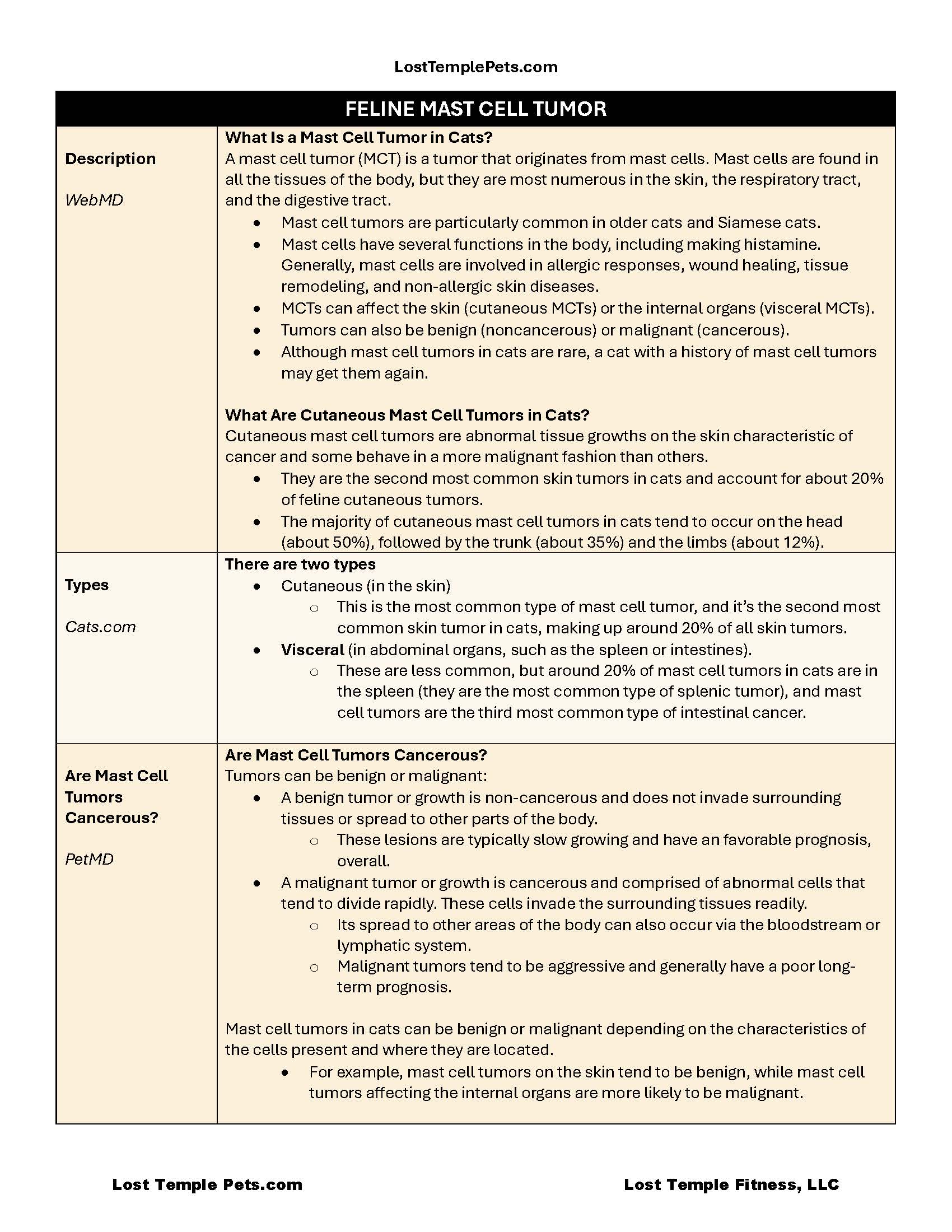
What Is a Mast Cell Tumor in Cats?
A mast cell tumor (MCT) is a tumor that originates from mast cells. Mast cells are found in all the tissues of the body, but they are most numerous in the skin, the respiratory tract, and the digestive tract.
- Mast cell tumors are particularly common in older cats and Siamese cats.
- Mast cells have several functions in the body, including making histamine. Generally, mast cells are involved in allergic responses, wound healing, tissue remodeling, and non-allergic skin diseases.
- MCTs can affect the skin (cutaneous MCTs) or the internal organs (visceral MCTs).
- Tumors can also be benign (noncancerous) or malignant (cancerous).
- Although mast cell tumors in cats are rare, a cat with a history of mast cell tumors may get them again.
What Are Cutaneous Mast Cell Tumors in Cats?
Cutaneous mast cell tumors are abnormal tissue growths on the skin characteristic of cancer and some behave in a more malignant fashion than others.
- They are the second most common skin tumors in cats and account for about 20% of feline cutaneous tumors.
- The majority of cutaneous mast cell tumors in cats tend to occur on the head (about 50%), followed by the trunk (about 35%) and the limbs (about 12%).
Two Types (Cats.com)
There are two types:
- Cutaneous (in the skin)
- This is the most common type of mast cell tumor, and it’s the second most common skin tumor in cats, making up around 20% of all skin tumors.
- Visceral (in abdominal organs, such as the spleen or intestines).
- These are less common, but around 20% of mast cell tumors in cats are in the spleen (they are the most common type of splenic tumor), and mast cell tumors are the third most common type of intestinal cancer.
Are Mast Cell Tumors Cancerous? (PetMD)
Are Mast Cell Tumors Cancerous?
Tumors can be benign or malignant:
- A benign tumor or growth is non-cancerous and does not invade surrounding tissues or spread to other parts of the body.
- These lesions are typically slow growing and have an favorable prognosis, overall.
- A malignant tumor or growth is cancerous and comprised of abnormal cells that tend to divide rapidly. These cells invade the surrounding tissues readily.
- Its spread to other areas of the body can also occur via the bloodstream or lymphatic system.
- Malignant tumors tend to be aggressive and generally have a poor long-term prognosis.
Mast cell tumors in cats can be benign or malignant depending on the characteristics of the cells present and where they are located.
- For example, mast cell tumors on the skin tend to be benign, while mast cell tumors affecting the internal organs are more likely to be malignant.
Mast Cell Tumor Videos
YouTube Videos that help explain Mast Cell Tumors in Cats
Disclaimer:
This is for research only and Lost Temple Pets does not endorse any video presented on this website.
It is advised that you ALWAYS CHECK WITH YOUR VETERINARIAN for a proper diagnosis and treatment plan.
Playlist
Causes
What Causes this Cancer? (VCA)
What causes this cancer?
Why a particular cat may develop MCT or any cancer is not straightforward. Very few cancers have a single known cause.
- Most seem to be caused by a complex mix of risk factors, some environmental and some genetic or hereditary.
- A genetic mutation in a protein involved in the replication and division of cells (called KIT) has been well-described in the development of MCTs in dogs.
- In cats, about 67% of MCTs also have this mutation.
Causes of Mast Cell Tumors in Cats (PetMD)
Causes of Mast Cell Tumors in Cats
While the exact cause of mast cell tumors is not fully known, both genetics and environmental factors are suspected to play a role.
- For example, Siamese cats tend to be prone to the development of cutaneous mast cell tumors.
In dogs, there is a mutation present in a specific gene, referred to as KIT, that’s associated with the development of mast cell tumors.
- The KIT protein plays a role in cell replication and division.
- A mutation in the KIT has also been detected in cats with mast cell tumors.
Signs / Symptoms
Signs of Mast Cell Tumors in Cats (Catster)
Signs of Mast Cell Tumors in Cats
The signs of mast cell tumors in cats are variable. They depend largely on which of the above three organs are affected, how aggressive the tumor is, and how far the cancer has progressed.
Cutaneous
If the tumor is on the skin, you may notice a firm plaque (hard, flattened area) or a lump under the skin; however, mast cell tumors can take on many different appearances.
- While they commonly occur around the head and neck, other parts of the skin can be affected.
- The lesion may be itchy as a result of histamine release by the tumor.
Splenic
If your cat has the splenic form of disease, weight loss, vomiting and loss of appetite are common signs.
- These signs are vague or “non-specific” and can be confused with other diseases.
Intestines
If the tumor affects the intestines (bowels), gastrointestinal signs are more common.
- These include vomiting and diarrhea.
- Fresh red blood may be visible in your cat’s stool, or the stool may have a dark/tarry appearance (representing digested blood).
- Weight loss and reduced appetite are also possible.
Unfortunately, feline mast cell tumors can spread to neighboring organs and lymph nodes.
What Are The Clinical Signs? (NC State Veterinary Hospital)
What Are The Clinical Signs?
Feline cutaneous mast cell tumors vary in appearance.
- Many cats have no signs other than the presence of the tumor(s).
- Some tumors may look like raised white or red bumps within or below the skin’s surface. Others appear as red, ulcerated, bleeding, bruised, and swollen growths.
- Some tumors appear and remain the same size for months or years, while others show a rapid growth pattern over days or weeks.
- They can also increase and decrease in size over time.
- Tumors can be irritating, and cats can scratch, lick, or bite the mass and surrounding skin.
Cats with visceral or intestinal mast cell tumors usually show signs of sickness, such as vomiting, loss of appetite, diarrhea, and lethargy.
- More severe signs are associated with a more extensive disease burden (e.g., internal spread), but some cats are very sick with only a small amount of disease.
Testing / Diagnostics
Diagnosis of Mast Cell Tumor (Cats.com)
Diagnosis of Mast Cell Tumor
If your DVM veterinarian suspects that your cat may have a mast cell tumor, the following steps may be taken.
- Detailed History Taking
- Your vet will discuss every aspect of your cat’s condition and overall health care. There are other causes of the same types of signs as mast cell tumor, and this history will help to differentiate the various possible causes.
- If there is a lump, when did it appear? How rapidly has it been growing?
- Physical Examination
- Your veterinarian will check your cat over carefully, all over. This will include palpating your cat’s body, feeling for any unusual lumps or bumps, both internal and external.
- Your cat’s superficial lymph nodes will be checked for any enlargement. Any abnormalities at all will be noted, and may be helpful towards making a diagnosis and staging of a mast cell tumor.
- Routine Blood and Urine Tests
- As part of a minimum database when working up a sick cat, vets often carry out routine blood work, including the usual panel of diagnostic tests, such as hematology (complete blood count) and biochemistry profiles.
- Full urinalysis will also usually be undertaken. These tests are a useful way of checking for any other underlying illnesses, and the results act as a useful baseline, even if no abnormality is found.
- Specialized Blood Tests
- Your veterinarian may recommend specific blood tests for some viral infections such as FeLV and FIV, since there are significant implications if your cat is positive for either of these.
- Diagnostic Imaging
- Radiography (x-rays) and abdominal ultrasound may be carried out, to examine your cat’s internal organs for possible spread of mast cell tumors, and to screen your cat for other internal diseases.
- These investigations are not just important for making the initial diagnosis: they are also part of the staging process, searching for any evidence of metastases which would help with decision making around treatment plans.
- Biopsies
- If an abnormal mass is located (whether in the skin, or internally), a biopsy (sample of living tissue) is the only way that a mast cell tumor can be definitively diagnosed. This usually involve a Fine Needle Aspirate (FNA), which is how a diagnosis of mast cell tumor is usually made.
- Cytology will be carried out these fine needle aspiration samples, with a pathologist examining the samples, checking for high levels of mast cells.
- Sometimes, an initial sample may simply confirm the broad diagnosis of “mast cell tumor” and a second, larger, biopsy sample (e.g. a core biopsy, or an excisional biopsy, by excision of the entire tumor) may be needed for full histopathology, to discover more detailed information about the nature of the mast cell tumor.
Grade
Mast cell tumors are usually graded, from low grade to high grade, but the system of classification in cats is far less detailed than that used for canine mast cell tumors.
Treatment
What Are The Treatment Options? (NC State Veterinary Hospital)
What Are The Treatment Options?
We recommend surgery for nearly all cutaneous tumors as some may be more aggressive than others, and this cannot be determined by visual appearance.
- This is true for cats presenting with multiple tumors at the same time or cats who develop more than one mast cell tumor over time.
- The tumor must be submitted to a pathologist to evaluate (among other things) two critical pieces of information: data regarding the appearance of the cells, which helps determine their potential for spread, and whether the tumor was removed entirely.
- For some cats, the first surgery does not remove the entire tumor.
- Options include a second surgery, radiation therapy, or monitoring for regrowth.
When cutaneous mast cell tumors appear in groups, are too large for surgery, or have spread, surgery is insufficient.
- In those cases, chemotherapy plays a role.
- There are intravenous (injectable) and oral options.
- Chemotherapy can also be used instead of surgery or radiation therapy to limit the regrowth of an incompletely removed tumor, but the efficacy is unclear.
The prognosis for feline cutaneous mast cell tumors depends on the biopsy features, extent of disease, and ability to achieve adequate local control of tumors.
- Metastasis, especially beyond a nearby lymph node, indicates a more aggressive clinical course.
- Monitoring for new masses is essential in such cases, and rapid evaluation is recommended for any cat with a skin mass.
- Benign tumors are cured with surgery.
- The prognosis for cats with more aggressive cutaneous mast cell tumors is about one year, on average. This varies depending on the patient.
Surgery is also recommended for cats with visceral or intestinal mast cell tumors.
- If the disease is too widespread, surgery may not be an option.
- For those cats, chemotherapy plays a role in treatment.
- The prognosis for cats with gastrointestinal mast cell tumors is variable but can be 1-2 years with aggressive treatment.
- For cats with splenic tumors, the prognosis after surgery is an average of about 14 months (compared to 4-6 months without surgery).
- A subset of cats with both cutaneous mast cell tumors benefit from removing their spleens, meaning their skin lesions resolve with this surgery.
- Some cats have a more rapid progression of disease and shorter survival.
Management / Care
How Do I Care for a Cat With a Mast Cell Tumor? (Catster)
How Do I Care for a Cat With a Mast Cell Tumor?
Caring for a cat with a mast cell tumor requires you to work closely with a trusted veterinarian.
- There are no at-home fixes for mast cell tumors, and it isn’t recommended to leave them untreated (unless your cat is in a palliative-care state).
- Surgical removal of tumors is the most common treatment.
It is important to note that surgery is always performed under general anesthesia in cats.
- For mast cell tumors of the skin, this may be the only treatment necessary to achieve a cure, though the risk of recurrence certainly exists.
- For splenic and intestinal mast cell tumors, a combination of surgery and chemotherapy may be necessary. Your veterinarian will discuss this with you in more detail.
Antihistamine and antacid medications are often prescribed to help your cat feel better.
- Following surgery, pain relief is necessary.
- Cats undergoing chemotherapy may require antibiotics and anti-nausea medications, too.
- Treating aggressive mast cell tumors can be fairly involved, requiring frequent discussions with your vet and several visits to the vet clinic for check-ups.
References
References
Cats.com – Mast Cell Tumors in Cats: Symptoms, Diagnosis & Treatment
Written by Dr. Pete Wedderburn, DVM; Last updated Mar 8, 2024
https://cats.com/mast-cell-tumors-in-cats
Catster – Mast Cell Tumors in Cats: Signs, Causes, Care & FAQ (Vet Answer)
By Dr. Joe Mallat · Written by Dr. Joe Mallat; Updated on June 19, 2025
https://www.catster.com/ask-the-vet/mast-cell-tumors-in-cats/
NC State Veterinary Hospital (NC University) Medical Oncology: Feline Mast Cell Tumors
PetMD by Chewy – Mast Cell Tumors in Cats
By Dr. Krystal Dickinson; Published Oct. 26, 2022
https://www.petmd.com/cat/conditions/cancer/mast-cell-tumors-cats
VCA Animal Hospital – Mast Cell Tumors in Cats
By Krista Williams, BSc, DVM, CCRP; Debbie Stoewen DVM, MSW, RSW, PhD; Christopher Pinard, DVM
https://vcahospitals.com/know-your-pet/mast-cell-tumors-in-cats
WebMD – What to Know About Mast Cell Tumors in Cats
By Jeffrey Weishaupt; Medically Reviewed by Amy Flowers, DVM on March 08, 2024
https://www.webmd.com/pets/cats/what-to-know-mast-cell-tumors-cats