
Feline
Squamous Cell
Carcinoma
Research, Resources & Education
This website is based on research and is NOT created to diagnose your pet.
Each animal is an individual and may exhibit symptoms in a different way.
It is advised that you ALWAYS CHECK WITH YOUR VETERINARIAN for a proper diagnosis and treatment plan.
Table of Contents
Feline Squamous Cell
Carcinoma
Squamous cell carcinoma (SCC) is a tumor of skin cells. The skin is made up of several layers of cells with the squamous layer at the top.
Given that this type of cancer arises from squamous cells, tumors can develop anywhere that these cells are present.
This can include the nail bed, ear tips (pinnae), nose, and corner of the eyes.
(VCA)
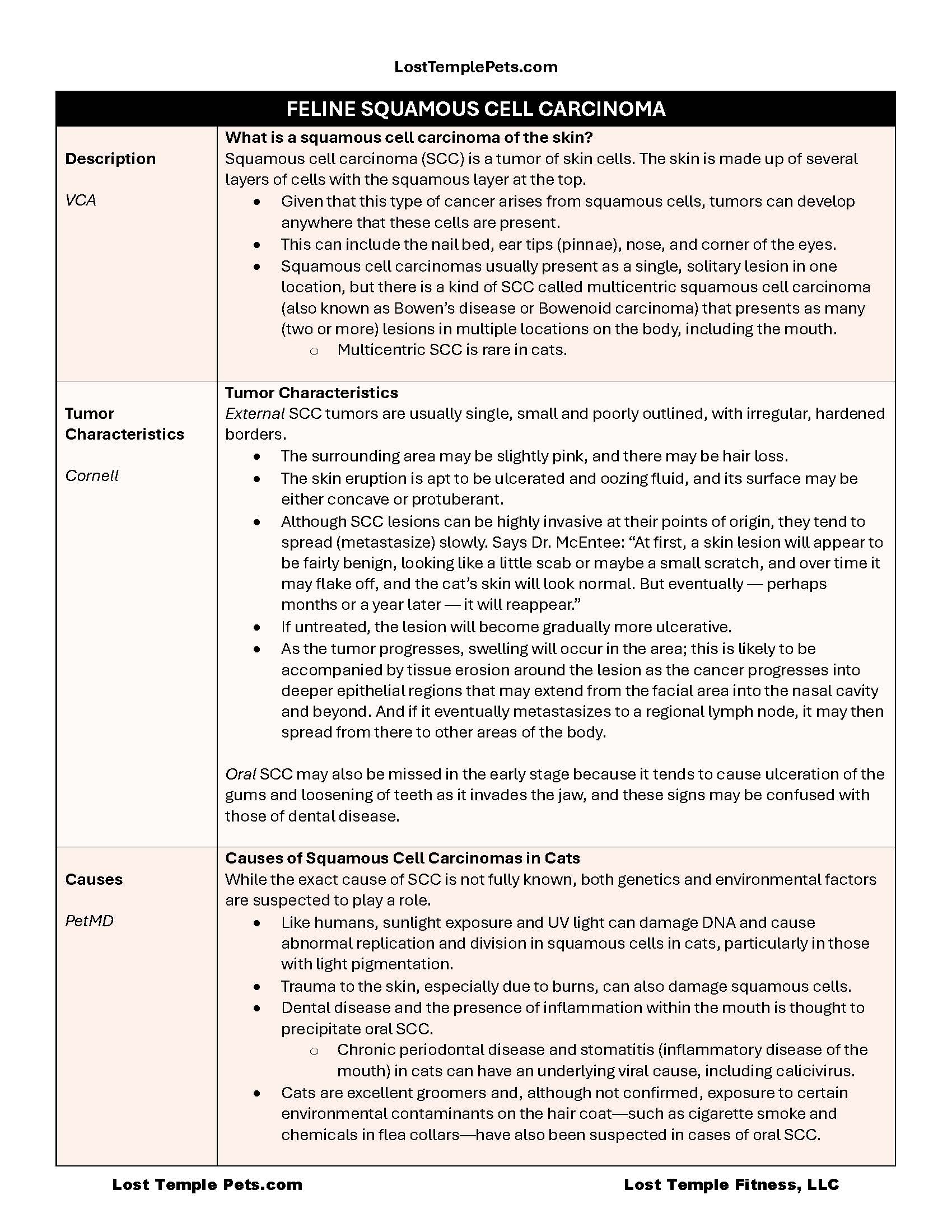
What is Squamous Cell Carcinoma?
What is a Squamous Cell Carcinoma of the Skin? (VCA)
What is a Squamous Cell Carcinoma of the Skin?
Squamous cell carcinoma (SCC) is a tumor of skin cells. The skin is made up of several layers of cells with the squamous layer at the top.
- Given that this type of cancer arises from squamous cells, tumors can develop anywhere that these cells are present.
- This can include the nail bed, ear tips (pinnae), nose, and corner of the eyes.
- Squamous cell carcinomas usually present as a single, solitary lesion in one location, but there is a kind of SCC called multicentric squamous cell carcinoma (also known as Bowen’s disease or Bowenoid carcinoma) that presents as many (two or more) lesions in multiple locations on the body, including the mouth.
- Multicentric SCC is rare in cats.
Tumor Characteristics (Cornell)
Tumor Characteristics
External SCC tumors are usually single, small and poorly outlined, with irregular, hardened borders.
- The surrounding area may be slightly pink, and there may be hair loss.
- The skin eruption is apt to be ulcerated and oozing fluid, and its surface may be either concave or protuberant.
- Although SCC lesions can be highly invasive at their points of origin, they tend to spread (metastasize) slowly. Says Dr. McEntee: “At first, a skin lesion will appear to be fairly benign, looking like a little scab or maybe a small scratch, and over time it may flake off, and the cat’s skin will look normal. But eventually — perhaps months or a year later — it will reappear.”
- If untreated, the lesion will become gradually more ulcerative.
- As the tumor progresses, swelling will occur in the area; this is likely to be accompanied by tissue erosion around the lesion as the cancer progresses into deeper epithelial regions that may extend from the facial area into the nasal cavity and beyond. And if it eventually metastasizes to a regional lymph node, it may then spread from there to other areas of the body.
Oral SCC may also be missed in the early stage because it tends to cause ulceration of the gums and loosening of teeth as it invades the jaw, and these signs may be confused with those of dental disease.
Feline Squamous Cell Videos
YouTube Videos that help explain Squamous Cell Carcinoma in Cats.
Disclaimer:
This is for research only and Lost Temple Pets does not endorse any video presented on this website.
It is advised that you ALWAYS CHECK WITH YOUR VETERINARIAN for a proper diagnosis and treatment plan.
Playlist
Causes
Causes of Squamous Cell Carcinomas in Cats (PetMD)
Causes of Squamous Cell Carcinomas in Cats
While the exact cause of SCC is not fully known, both genetics and environmental factors are suspected to play a role.
- Like humans, sunlight exposure and UV light can damage DNA and cause abnormal replication and division in squamous cells in cats, particularly in those with light pigmentation.
- Trauma to the skin, especially due to burns, can also damage squamous cells.
- Dental disease and the presence of inflammation within the mouth is thought to precipitate oral SCC.
- Chronic periodontal disease and stomatitis (inflammatory disease of the mouth) in cats can have an underlying viral cause, including calicivirus.
- Cats are excellent groomers and, although not confirmed, exposure to certain environmental contaminants on the hair coat—such as cigarette smoke and chemicals in flea collars—have also been suspected in cases of oral SCC.
Signs & Stages
What Are the Signs & Stages of Squamous Cell Carcinoma in Cats? (Catster)
What Are the Signs of Squamous Cell Carcinoma in Cats?
The most common area where squamous cell carcinomas occur is the face, especially the ears. Other high-risk areas are those with maximum sun exposure.
Clinical signs of squamous cell carcinoma include:
- Irritation of the area
- Weeping sores
- Crusts
- Ulceration
- Local bleeding
- Signs of oral carcinoma may include:
- Loss of appetite
- Weight loss
- Swallowing with difficulty
- Bad breath
- Excessive salivation (sometimes with blood)
Ears
When affecting the ears, squamous cell carcinoma usually presents with dark, crusting lesions on the tips of the ears, which may bleed or cause irritation.
Bowenoid carcinoma or Bowen’s disease.
Squamous cell carcinomas usually present as a solitary lesion (i.e., it occurs in a single area). However, there is a type of squamous cell carcinoma that is known as Bowenoid carcinoma or Bowen’s disease.
- This carcinoma is a multicentric squamous cell carcinoma and occurs in several areas of the body but is not technically a metastatic cancer.
Stages
In some cases, squamous cell carcinoma may appear as a raised, red area or cauliflower shape. It also has two stages:
- Initial stage: Red-pink nodular lesions appear. They are firm in consistency, with raised edges.
- The carcinoma looks like a firm skin nodule.
- Advanced stage: The tumor has a variable, irregular diameter and is ulcerated. The advanced phase is often associated with regional adenopathy (enlarged local lymph nodes).
Diagnostics
How is this cancer diagnosed? (VCA)
How is this cancer diagnosed?
Depending on where the tumor develops (i.e., the skin or nail bed), a diagnosis may be achieved with a fine needle aspiration (FNA).
- FNA involves taking a small needle with a syringe and suctioning a sample of cells directly from the tumor and placing them on a microscope slide. A veterinary pathologist then examines the slide under a microscope.
In some cases, results from FNA may not be entirely clear and a biopsy may be necessary.
- A biopsy is a surgical excision of a piece of the tumor. Pieces of the tumor are then examined by a veterinary pathologist under the microscope. This is called histopathology.
- Histopathology is helpful in making a diagnosis and can indicate how the tumor is likely to behave.
In cases of tumors of the toe(s), radiographs (X-rays) may be especially helpful in making a diagnosis. In cats, about 90% of carcinomas of the toes are actually cancer that had spread to the toe from the lungs.
- Lung cancer in cats tends to selectively spread (metastasize) to the nailbeds and toes.
- This is called lung-digit syndrome.
- Radiographs of the chest, therefore, are necessary to determine if the tumor in the toe area is truly SCC of the toe (i.e. primary) or if it is secondary to lung cancer.
Care
How Do I Care for a Cat With Squamous Cell Carcinoma? (Catster)
How Do I Care for a Cat With Squamous Cell Carcinoma?
If your vet recommends surgical excision of your cat’s squamous cell carcinoma, time is of the essence.
- The earlier the mass is removed, the higher the chance of success.
- Once the tumor grows into deeper tissues, particularly if it affects the bone, prognosis is much less favorable.
If your cat has been diagnosed with oral squamous cell carcinoma, surgery may not be recommended, depending on the size and location of the mass.
- You may be referred to a veterinary oncologist to discuss the options.
- Even if you opt for palliative (end of life) treatment, which is very reasonable with this form of the cancer, it is always good to know your options.
The most important factor in caring for a cat with inoperable squamous cell carcinoma is monitoring their quality of life.
- Anti-inflammatories and antibiotics will help to keep them comfortable, but eventually, eating and swallowing will become difficult, and you will need to make a decision about euthanasia.
Treatment
Treatment. Recovery & Management of Squamous Cell Carcinomas in Cats (PetMD)
Treatment of Squamous Cell Carcinomas in Cats
The recommended treatment protocol for SCC will depend on the location of the tumor (or tumors) and the invasive progression of the disease.
- The best treatment option for cutaneous SCC is surgical removal.
- The prognosis is favorable if the entirety of the tumor can be removed.
- Cryosurgery (the use of extreme cold to destroy diseased tissue) can be performed if the tumor is small.
- SCC in other areas of the body, where surgery has a less favorable outcome, may require a more extensive treatment protocol that includes radiation therapy.
- Tumors present on the nose are commonly treated this way.
- This procedure will likely require a referral to a veterinary oncologist (cancer specialist).
- Oral SCC can be treated with a combination of surgery and radiation. However, these tumors must be addressed in the early stages for the most successful outcomes and, even then, an overall poor prognosis is possible.
Recovery and Management of Squamous Cell Carcinomas in Cats
It is important to follow your veterinarian’s instructions once your pet is discharged to return home.
- Your veterinarian will likely prescribe medications to help prevent negative side effects during recovery.
- Anti-nausea, appetite stimulants, and pain medications are common examples.
- An E-collar (recovery cone) will likely be needed to prevent any self-trauma or injury to surgical sites during the post-operative healing process.
- It is also important to keep any surgical sites clean and dry and limit your pet’s activity for at least 10 to 14 days to prevent dehiscence (opening of the wound).
- If you have any concerns while your pet is recovering at home, promptly contact your veterinary clinic.
- For a light-pigmented cat, it may be helpful to limit its time in the sun to prevent large amounts of UV exposure.
References
References
Catster – Squamous Cell Carcinoma in Cats: Causes, Signs & Treatments (Vet Answer)
By Catster · Updated on June 19, 2025
https://www.catster.com/ask-the-vet/squamous-cell-carcinoma-in-cats/
Cornell Feline Health Center – Squamous Cell Cancer: Dangerous
Merck Veterinary Manual (Pet Owner Version) – Tumors of the Skin in Cats
By Alice E. Villalobos, DVM, Pawspice & Animal Oncology Consultation Service
Reviewed/Revised Aug 2018 | Modified Sept 2024
PetMD by Chewy – Squamous Cell Carcinomas in Cats
By Dr. Krystal Dickinson; Published Oct. 26, 2022
https://www.petmd.com/cat/conditions/cancer/squamous-cell-carcinomas-cats
VCA Animal Hospital – Squamous Cell Carcinomas in Cats
By Malcolm Weir, DVM, MSc, MPH; Debbie Stoewen DVM, MSW, RSW, PhD; Christopher Pinard, DVM
https://vcahospitals.com/know-your-pet/skin-squamous-cell-carcinoma-in-cats
VIN – Feline Squamous Cell Carcinoma: Latest Information
World Small Animal Veterinary Association Congress Proceedings, 2017
Jolie Kirpensteijn, DVM, PhD, DACVS, DECVS
Hill’s Pet Nutrition, Topeka, KS, USA
https://www.vin.com/apputil/content/defaultadv1.aspx?pId=20539&id=8506189