
Feline
Transitional
Cell
Carcinoma
Research, Resources & Education
This website is based on research and is NOT created to diagnose your pet.
Each animal is an individual and may exhibit symptoms in a different way.
It is advised that you ALWAYS CHECK WITH YOUR VETERINARIAN for a proper diagnosis and treatment plan.
Table of Contents
Feline Transitional Cell Carcinoma
TCC
Transitional cell carcinoma (TCC) in cats is a rare but aggressive form of cancer that develops in the urinary tract’s lining, primarily affecting the bladder and urethra.
While uncommon compared to other feline health issues, this condition requires immediate attention and proper medical intervention due to its serious nature.
(Pet Care)
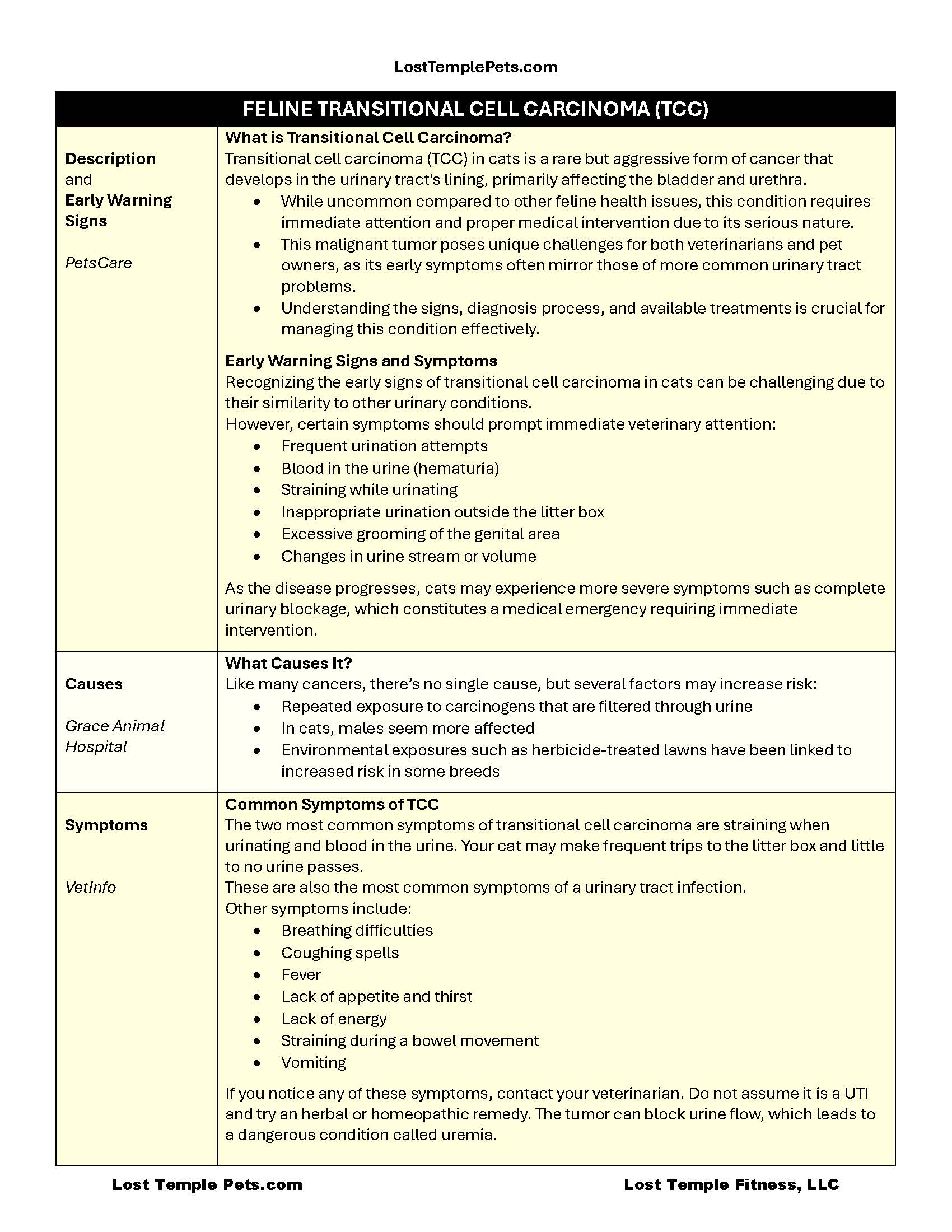
What is Transitional Cell Carcinoma?
What is Transitional Cell Carcinoma & Warning Signs (PetsCare)
What is Transitional Cell Carcinoma?
Transitional cell carcinoma (TCC) in cats is a rare but aggressive form of cancer that develops in the urinary tract’s lining, primarily affecting the bladder and urethra.
- While uncommon compared to other feline health issues, this condition requires immediate attention and proper medical intervention due to its serious nature.
- This malignant tumor poses unique challenges for both veterinarians and pet owners, as its early symptoms often mirror those of more common urinary tract problems.
- Understanding the signs, diagnosis process, and available treatments is crucial for managing this condition effectively.
Early Warning Signs and Symptoms
Recognizing the early signs of transitional cell carcinoma in cats can be challenging due to their similarity to other urinary conditions.
However, certain symptoms should prompt immediate veterinary attention:
- Frequent urination attempts
- Blood in the urine (hematuria)
- Straining while urinating
- Inappropriate urination outside the litter box
- Excessive grooming of the genital area
- Changes in urine stream or volume
As the disease progresses, cats may experience more severe symptoms such as complete urinary blockage, which constitutes a medical emergency requiring immediate intervention.
Causes
What Causes It? (Grace Animal Hospital)
What Causes It?
Like many cancers, there’s no single cause, but several factors may increase risk:
- Repeated exposure to carcinogens that are filtered through urine
- In cats, males seem more affected
- Environmental exposures such as herbicide-treated lawns have been linked to increased risk in some breeds
Symptoms
Common Symptoms of TCC (VetInfo)
Common Symptoms of TCC
The two most common symptoms of transitional cell carcinoma are straining when urinating and blood in the urine. Your cat may make frequent trips to the litter box and little to no urine passes.
These are also the most common symptoms of a urinary tract infection.
Other symptoms include:
- Breathing difficulties
- Coughing spells
- Fever
- Lack of appetite and thirst
- Lack of energy
- Straining during a bowel movement
- Vomiting
If you notice any of these symptoms, contact your veterinarian. Do not assume it is a UTI and try an herbal or homeopathic remedy. The tumor can block urine flow, which leads to a dangerous condition called uremia.
Clinical Findings of Lower Urinary Tract Neoplasia (Merck Veterinary Manual)
Clinical Findings of Lower Urinary Tract Neoplasia
Hematuria, dysuria, stranguria, and pollakiuria are the most common clinical signs of lower urinary tract neoplasia.
- Animals with ureteral obstruction and unilateral hydronephrosis can show signs of abdominal pain and have a palpably enlarged kidney.
- Signs of uremia can be apparent in animals with bilateral ureteral obstruction and hydronephrosis or with urethral obstruction.
- The bladder wall may be thickened, and a cordlike urethra or urethral mass(es) may be palpable rectally.
Testing / Diagnostics
Diagnosis (PetMD)
Diagnosis
Your veterinarian will perform a complete physical exam on your cat, into account the background history of symptoms and possible incidents that might have led to this condition.
- You will need to provide a thorough history of your cat’s health leading up to the onset of symptoms.
- A complete blood profile will be conducted, including a chemical blood profile, a complete blood count, a urinalysis and an electrolyte panel.
- Urine should also be sent for culture and sensitivity testing since a concurrent urinary tract infection is common.
X-rays of the chest and abdomen should be taken to look for possible spread of the cancer.
- Intravenous pyelography, a procedure that is used to take an X-ray image of the urinary system, will be used to examine the urinary tract, bladder and kidneys. For this procedure, a contrasting dye will be injected into the bloodstream, to be picked up by the kidneys and passed through through the ureters, bladder and urethra.
- The contrasting dye is visible on the X-ray imaging so that the internal structures can be seen and determined to be functioning normally or abnormally.
- Other contrast dye procedures that can be used to image the urinary tract may be used, either instead of, or in addition to, a pyelography.
- They include a voiding urethrogram (x-rays of dyes as the patient urinates), or vaginogram (X-rays of dyes within the vagina).
- These latter X-ray techniques are indicated if urethral or vaginal disease is suspected.
- Double-contrast cystography is the best way to visualize the mass(es) which are normally located at the trigone of the urinary bladder (a smooth triangular area inside the bladder).
For a definitive diagnosis, a biopsy of the mass is the gold standard.
- Biopsies may be obtained through traumatic catheterization (jamming a catheter into the masses), exploratory laparotomy (abdominal surgery), or cystoscopy (using a small camera with instruments attached).
- However, ultrasound-guided biopsy is not recommended, because this can easily cause further spreading of the cancer.
Living with TCC
Living with TCC: Care and Support (PetsCare)
Living with TCC: Care and Support
Supporting a cat diagnosed with transitional cell carcinoma requires dedicated attention and care:
- Regular veterinary monitoring
- Maintaining proper hydration
- Ensuring easy litter box access
- Managing pain and discomfort
- Monitoring eating habits and weight
- Providing a stress-free environment
Treatment
Treatment & Recovery of Transitional Cell Carcinoma in Cats (Wag!)
Treatment of Transitional Cell Carcinoma in Cats
Depending on the severity and operability of the tumors and the age and general health of your cat, there are several different treatment options that may prolong the life of a cat affected with transitional cell carcinoma.
- Currently there is no known cure and most treatments are palliative in nature.
Surgery
If the TCC is in the form of an isolated tumor, surgery to remove the mass may significantly prolong the life of your cat.
- Given the aggressive nature of this type of cancer, surgery, when possible, is the most recommended course of treatment.
- Your cat will have to undergo anesthesia and a major surgical procedure where part of the bladder is removed.
- If the urethra is blocked at the time of surgery, tubes to clear the blockage and assist with your cat’s ability to urinate may be inserted at this time.
Chemotherapy and Radiation
Chemotherapy or a form of radiation therapy is also an option, either in connection with surgical removal of the tumor, or on its own.
- In chemotherapy, your cat will be injected with a chemotherapy drug which will work to target and kill the cancer cells.
- In radiation treatments, specific strengths of radiation are targeted in the area of your cat’s tumor.
- Radiation and chemotherapy can both cause damage to surrounding tissues and cells.
- They also can cause additional symptoms such as lethargy, loss of appetite and increased risk of infection or sickness.
- Certain drugs can be given to help lessen these symptoms.
Recovery of Transitional Cell Carcinoma in Cats
With current technologies, all treatment of transitional cell carcinoma in cats is considered palliative.
- This means that treatment is meant to alleviate the physical pain and discomfort of the disease and lengthen the life of your cat.
- With a well-developed and consistent treatment, your cat’s lifespan may be extended by eight months to a year or more.
References
References
Grace Animal Hospital – Understanding Transitional Cell Carcinoma in Dogs and Cats
October 24, 2025
https://www.graceanimalhospital.com/blog/understanding-transitional-cell-carcinoma-in-dogs-and-cats
Merck Veterinary Manual (Professional Version) – Neoplasia of the Urinary System in Dogs and Cats
By Laura Van Vertloo, DVM, MS, DACVIM, Iowa State University, College of Veterinary Medicine
Reviewed By Joyce Carnevale, DVM, DABVP, College of Veterinary Medicine, Iowa State University; Reviewed/Revised Mar 2025 | Modified Apr 2025
PetsCare – Understanding Transitional Cell Carcinoma in Cats: Symptoms, Treatment, and Care
https://www.petscare.com/news/post/transitional-cell-carcinoma-cats
PetMD by Chewy – Transitional Cell Carcinoma of the Urinary Tract in Cats
By PetMD Editorial; Published Mar. 20, 2010
https://www.petmd.com/cat/conditions/cancer/c_ct_urinary_carcinoma
VetInfo – Transitional Cell Carcinoma in Cats
https://www.vetinfo.com/transitional-cell-carcinoma-in-cats.html
Wag! – Transitional Cell Carcinoma in Cats
https://wagwalking.com/cat/condition/transitional-cell-carcinoma